
Discover how tourism supports wildlife conservation, anti-poaching efforts, local employment and community development around Kruger National Park through SANParks initiatives and Fair Trade Tourism.
Baboons in Kruger: Funny, Fascinating, and Not to Be Underestimated
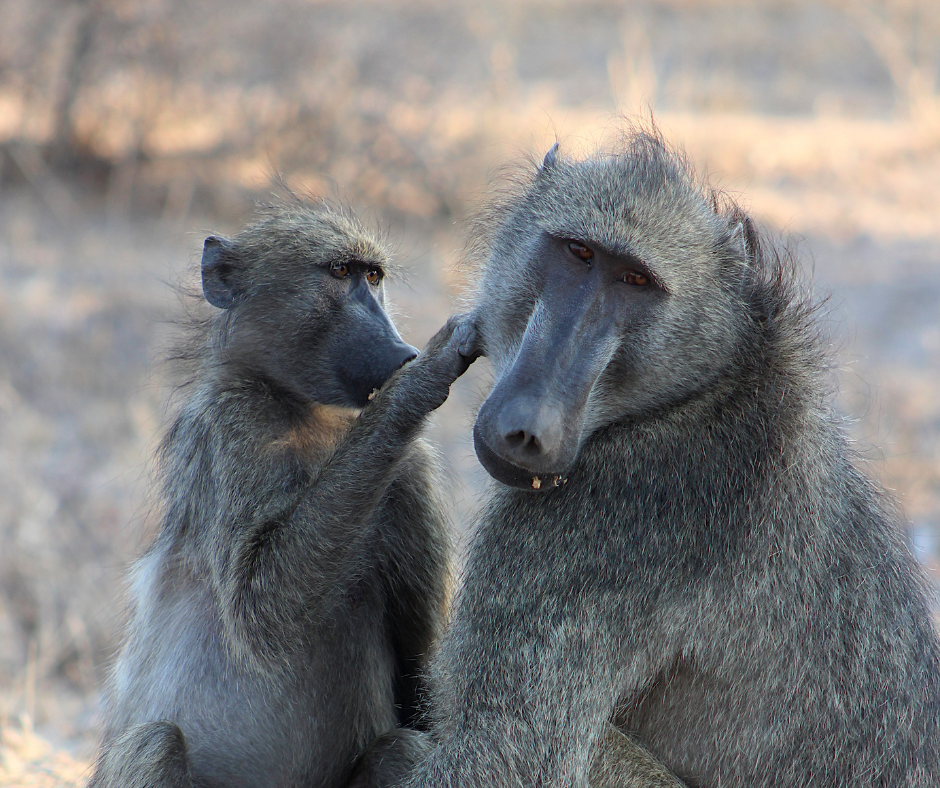
Discover the fascinating world of baboons in Kruger National Park and Marloth Park. Learn about their behaviour, intelligence, safety tips, and where to spot them near Needles Lodge.
HTML
Discover the complex, comical, and surprisingly dangerous world of baboons in Kruger National Park. Learn how to read their behaviour, enjoy their company safely, and why they deserve far more respect than most visitors give them.
Most first-time visitors to Kruger see a baboon and laugh. And honestly, who can blame them—they're ridiculous. The facial expressions, the squabbles, the juvenile ones staging what appears to be a completely unnecessary drama over a piece of bark. It's like stumbling onto a soap opera that's been running for two million years.
Most locals see a baboon and laugh too but they also quietly move their food inside, check that the windows are closed, and keep one eye on the big male at the back. There's a reason for that. Several, actually.
Who Exactly Are They?
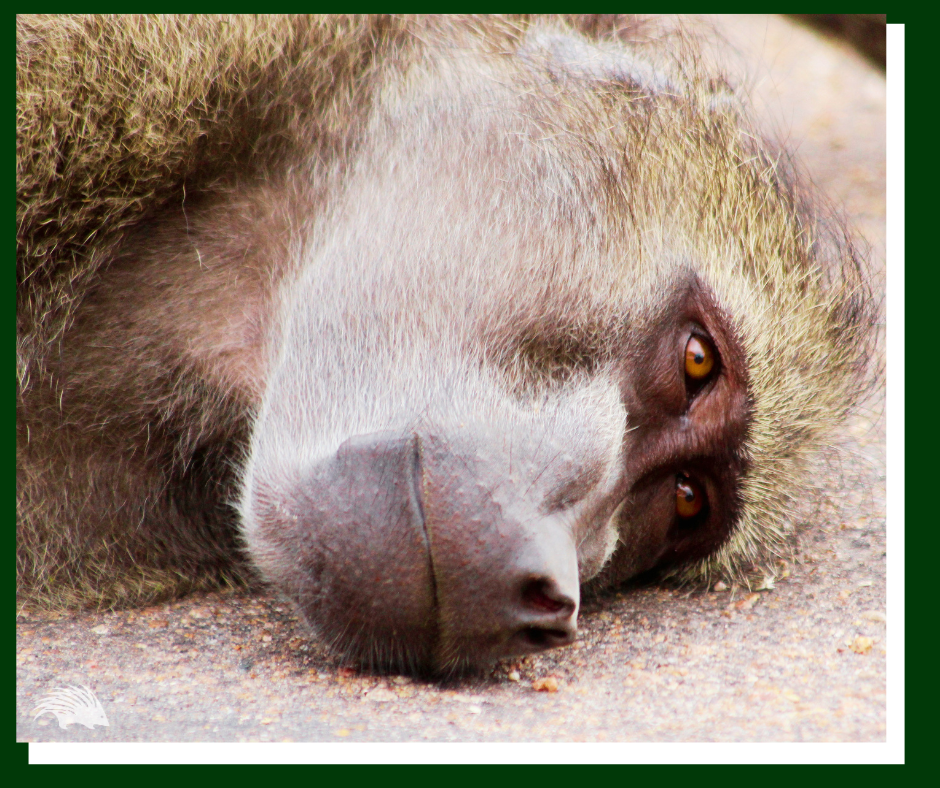
At first glance, a baboon might seem an unlikely candidate for nature's hall of fame. They don't have the grace of a leopard or the majesty of an elephant. They're not particularly beautiful in the conventional sense—a dog-like muzzle, close-set amber eyes, a somewhat ungainly walk that swings between purposeful and utterly ridiculous. But here's the thing: look closer. Always look closer.
The chacma baboon is the largest baboon species in the world. A fully grown male can weigh up to 45 kilograms and stand almost a metre tall. Those canine teeth—which he will flash with alarming frequency, usually at exactly the wrong moment—can measure up to five centimetres. They are absolutely not for show.
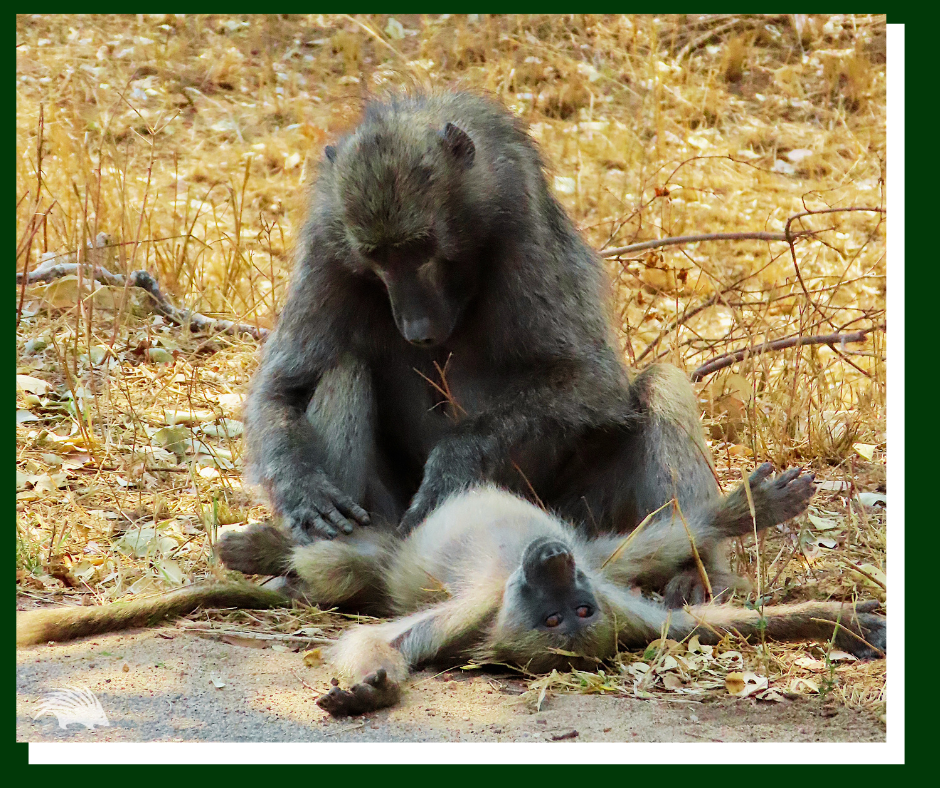
Their coats range from grey-brown to olive, and they carry an expression that is, frankly, uncannily familiar. And that's the point. We share roughly 94% of our DNA with baboons. Watch them for long enough and you start to see it everywhere—in the way a youngster pesters its mother. In the way the teenagers are off to one side, mock-fighting. In the way an old male sits slightly apart from it all, staring into the middle distance with the expression of someone who has seen too much. And in the way a mother pins down a squirming infant for a grooming session he very clearly did not consent to. They have such an eerlily familiarity to their interaction and socialisation.
The Politics of the Troop
If there is one thing that makes baboons genuinely extraordinary, it is this: they live lives of remarkable social complexity. A baboon troop in Kruger can number anywhere from 20 to well over 100 individuals. Within that troop, there is an entire world of alliance, betrayal, loyalty, rivalry, and real tenderness. Think of it less like a herd and more like—well, an office.
Males compete fiercely for dominance, and rank matters enormously. The alpha male gets first access to food, mates, and the choicest resting spots under the best shade trees. But baboon politics are not simply about brute strength. Friendships count. Coalitions count. A clever, well-connected male can outmanoeuvre a physically stronger rival through sheer social intelligence—which is, if you think about it, a strategy most of us have also attempted at some point.
Females form the stable backbone of the troop. Their hierarchy is largely inherited—daughters tend to rank just below their mothers—and it is the female bonds that endure long after males have transferred elsewhere. In baboon society, women keep things going.
And the young? The juveniles of Kruger are, without question, among the most entertaining creatures you will ever encounter. Chasing each other across termite mounds. Tumbling through the dust. Hanging upside down from acacia branches with expressions of absolute self-satisfaction. They play with an abandon and a joy that is impossible to watch without grinning.
What They Eat
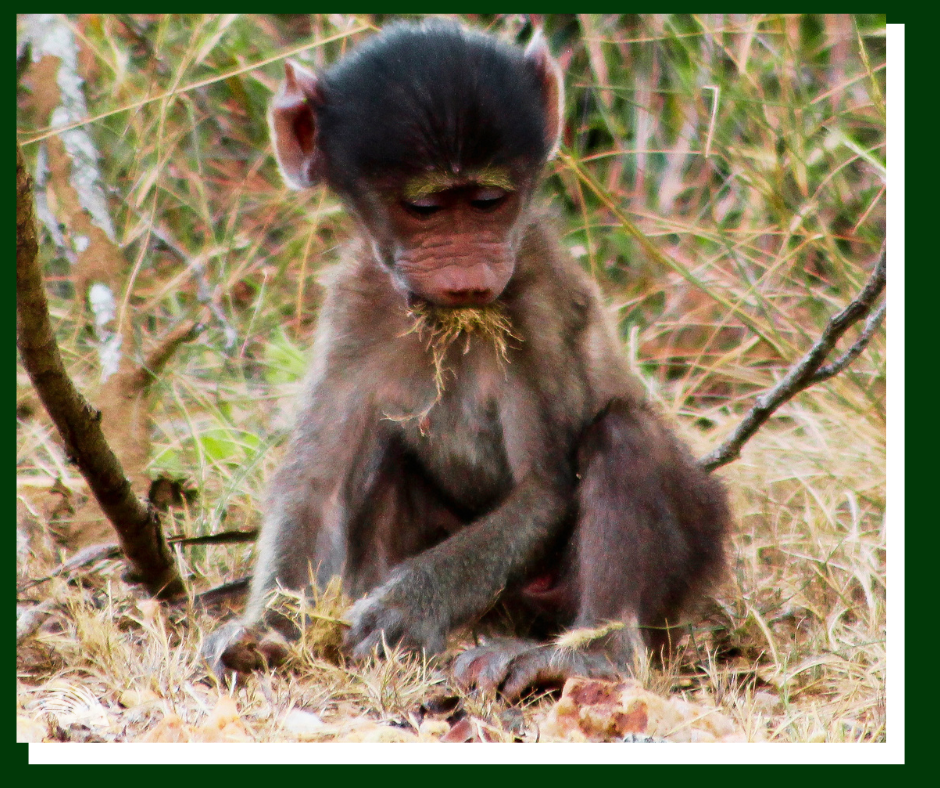
Baboons will eat almost anything. In the woodlands of Kruger, a troop forages across enormous distances each day—sometimes covering up to 15 kilometres—sampling whatever the bush happens to be offering. Grass, roots, tubers, wild fruits, seeds, flowers. Scorpions. Insects. The occasional small reptile. Eggs when they can find them. Young antelope if the opportunity presents itself.
This extraordinary dietary flexibility is precisely why they've thrived across sub-Saharan Africa where more specialised creatures struggle. They are nature's great opportunists—not in a cynical sense, but in the truest evolutionary sense. They adapt. They problem-solve. They remember. Studies have shown that baboons can recall the locations of seasonal fruit trees across vast home ranges.
Predators, Alarms, and the Art of Never Fully Relaxing
The bush is never entirely safe—not even for an animal as formidable as a large male baboon. Leopards are their most significant predator, and the relationship between the two species has been refined over thousands of years into something almost like a grudging mutual awareness. Baboons mob leopards loudly and relentlessly, sometimes driving them from kill sites entirely. Their alarm bark—sharp, percussive, and carrying a long way—is one of the most useful sounds in the bush. Impala, kudus, even birds have learned to pay attention when the baboons start going off.
Lions will take one caught alone. Martial Eagles sometimes target juveniles. Crocodiles wait patiently at the water's edge during the daily drink. It is a life lived at a constant hum of alertness.
They Are Funny. They Are Also Serious.
Baboons are genuinely amusing. Watching a troop work through their morning routine—the squabbles, the grooming sessions, the juveniles staging what appears to be a small coup—is genuinely one of the great pleasures of bush life. There are moments where you catch a facial expression so human, so perfectly timed, that you genuinely don't know whether to laugh or feel slightly unsettled.
But. They are wild animals. They are strong, fast, unpredictable, and when cornered or provoked, they are capable of causing serious injury. A male baboon in full threat display is not a creature you want to test.
Why They Actually Matter
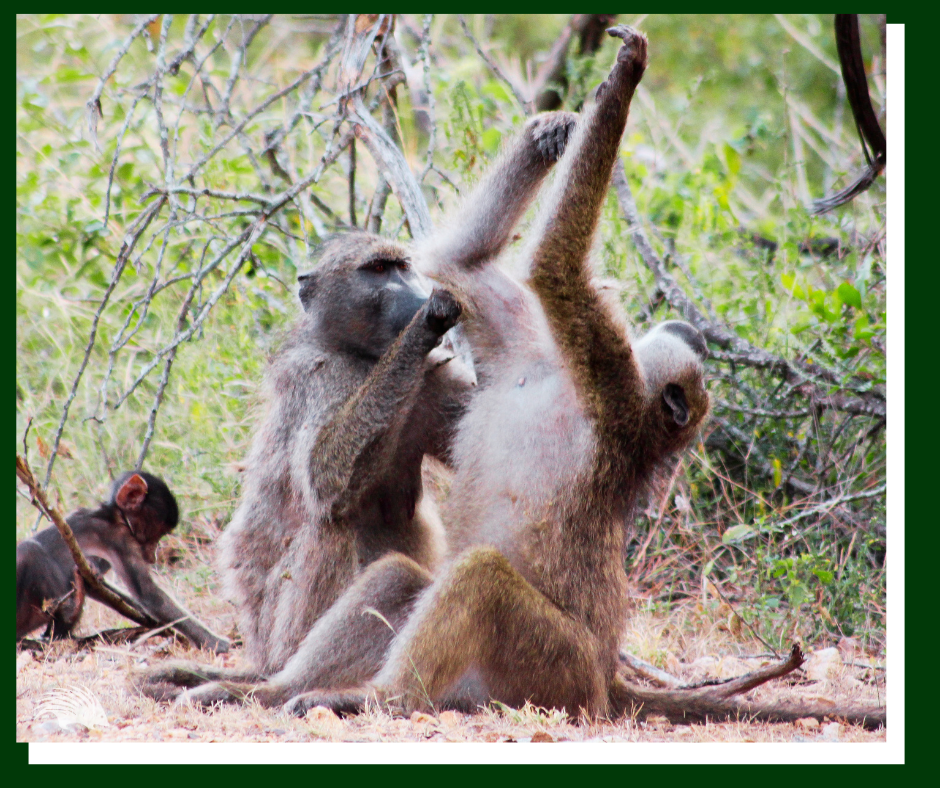
Here is something that often goes unappreciated. Baboons are not just consumers of the bush—they are active shapers of it. As they forage across Kruger's landscape, they scatter seeds across enormous distances, dispersing plants far beyond the reach of wind or gravity. They dig for roots and tubers, aerating the soil. They disturb insects to the surface, making them available to birds and small predators. Their presence at waterholes changes the behaviour of other species in ways that ripple outward through the whole system.
Remove them from the equation and you would not immediately notice the difference. But over time, slowly and surely, the landscape would shift—a little less diversity here, a change in plant composition there—until things were measurably, if quietly, worse. Every animal in Kruger has its role. Even the ones that steal your breakfast.
Where to See Them in Kruger
Within the park itself, baboon troops are found throughout, but a few areas offer reliably spectacular viewing:
- The Crocodile Bridge to Lower Sabie route is excellent—troops here frequently cross the road or forage in open grassland alongside impala and zebra.
- Permanent waterholes in the south and central regions attract troops at predictable times each day. Position yourself patiently and wait—the social theatre that plays out around a waterhole is worth every minute.
- Riverine woodland along the Sabie and Crocodile Rivers is prime baboon habitat, and the troops here tend to be large, well-established, and generous with their drama.
Needles Lodge sits just minutes from Crocodile Bridge Gate, putting this country easily within reach on a morning game drive. Our 8-day itinerary guide covers the routes in detail—baboon viewing included, alongside everything else Kruger has to offer.
How to Behave Around Them: The Actual Dos and Don'ts
- Do observe from a comfortable distance. From your vehicle, from the deck, through the fence. You will see more than you think, and they will behave far more naturally if you're not crowding them.
- Do keep all food completely out of sight and securely stored. This is the big one. Once a baboon associates humans with food, that association is almost impossible to break—and the animal almost always pays for it with its life eventually. A fed baboon is, as the saying goes, a dead baboon. It sounds dramatic. It isn't.
- Don't make sustained, direct eye contact with a dominant male. He will interpret it as a challenge. He has considerably more experience with those than you do, and considerably less to lose.
- Don't run. Ever. Running triggers a chase response, and you will not win that particular race.
- Don't approach a mother with a young infant, no matter how irresistible the baby looks—and they are very, very irresistible. The mother will not see it that way.
- Don't leave your car or lodge windows open. They are smarter than you think, quicker than you'd expect, and completely unbothered by the concept of private property.
Follow these, and sharing space with baboons is not just manageable—it's one of the genuine delights of life in the bush.
10 Quick Facts & Stats About the Chacma Baboon
- Size and Scale: Male Chacma baboons can weigh up to 45 kg, while females are roughly half that size, usually topping out at 20 kg.
- Formidable Weaponry: A male's canine teeth can reach 5 cm in length—longer than those of an apex predator like a lion in proportion to their body size.
- Genetic Cousins: We share approximately 94% of our DNA with baboons, which explains their eerily human-like social behaviors.
- Endurance Travelers: A troop can travel up to 15 kilometers in a single day while foraging for food.
- Vast Social Circles: While they average 20 to 50 members, some "super-troops" in high-resource areas have been recorded with over 100 individuals.
- Longevity: In the wild, baboons typically live for 20 to 30 years, though they can reach 45 years in protected environments.
- The Matriarchy: While males fight for dominance, the troop's true stability comes from the females, who stay with their birth troop for their entire lives.
- Powerful Voices: The "Wahoo" bark of a male baboon can be heard over 1 kilometer away, serving as a warning to predators or rival troops.
- Speed: Despite their awkward-looking gallop, baboons can reach speeds of up to 45 km/h.
- High-Altitude Residents: They are incredibly adaptable and can be found from sea level right up to 2,100 meters in the Drakensberg mountains.
The chacma baboon will never be everyone's favourite. They are too loud, too bold, too absolutely certain that whatever space you're occupying is actually theirs. They raid fruit trees, overturn bins, and stare at you with the unmistakable expression of someone who has heard your excuses before. But that is precisely what makes them so remarkable.
In a world that increasingly pushes wildlife to its margins, baboons refuse to be marginalised. They are clever enough to adapt, social enough to endure, and resilient enough to outlast circumstances that would defeat a more delicate creature. They are, in their own chaotic, compelling, thoroughly unbothered way, a masterpiece of evolution.
Next time a troop moves through the gardens at Needles Lodge—and they will, they always do—put down your coffee. Watch them. Really watch them. The politics, the tenderness, the perpetual motion of a society conducting its business in full public view. You might find, as we have, that it is one of the most quietly astonishing things the bush has to offer. Just don't leave your coffee unattended.
Further Reading

How Tourism Helps Conservation and Communities Around Kruger National Park
Tue August 11, 2026
Read This Article
Ten Fascinating Facts About the Spotted Hyena
Tue June 23, 2026
Read This Article
Discover 10 fascinating facts about the spotted hyena in Kruger National Park. Learn why hyenas are skilled hunters, highly intelligent, female-led, and one of Africa's most misunderstood predators.
Secretarybird: The Stalking Raptor on Stilts
Tue November 18, 2025
Read This Article
Discover the unique hunting style, behaviour, and habitat of the Secretarybird in Kruger and Marloth Park. Learn where to see these tall, terrestrial raptors near Needles Lodge.
Jackalberry: Shade Tree of the Riverine
Tue October 21, 2025
Read This Article
Discover the Jackalberry tree (Diospyros mespiliformis) in Marloth Park and Kruger — its ecology, wildlife role, conservation, and why you’ll remember it on safari.
10 Curious Facts About Giraffes
Thu November 30, 2023
Read This Article
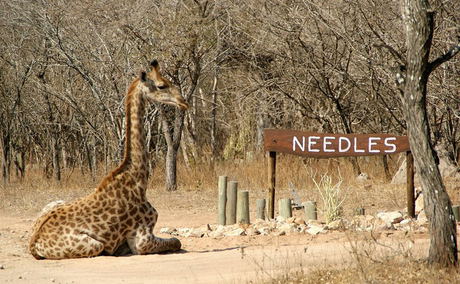
The article highlights giraffes in Kruger National Park, detailing ten unique aspects like their height, distinctive spot patterns, silent communication, powerful hearts, graceful movement, defensive kick, synchronized drinking, short naps, birth rituals, and large appetite. It also introduces Needles Lodge, a luxurious accommodation within the park, offering guests close-up encounters with giraffes and other wildlife, ideal for both nature lovers and those seeking a peaceful getaway.
Share This Post