
Discover the Jackalberry tree (Diospyros mespiliformis) in Marloth Park and Kruger — its ecology, wildlife role, conservation, and why you’ll remember it on safari.
Everything you need to know about the Red-billed Oxpecker (Buphagus erythrorhynchus) and the Yellow-billed Oxpecker (Buphagus africanus): what they eat, which animals they prefer, why some hosts reject them, and what research says about whether the arrangement is as mutual as it looks.
An oxpecker on a buffalo's back is one of the more familiar sights of the African savanna. The bird clings sideways to the hide, works its flattened bill through the hair, and the buffalo stands there, apparently indifferent. It looks like a straightforward arrangement. It is not.
Oxpeckers have been studied in detail for decades and the relationship between bird and host turns out to be considerably more complicated than the textbook version suggests. Here are ten things worth knowing about them.
1. There Are Only Two Species, and They Are More Closely Related to Starlings Than Anything Else
The oxpeckers form their own family, Buphagidae, with just two species: the Red-billed Oxpecker and the Yellow-billed Oxpecker. For a long time their closest relatives were uncertain. Genetic analysis has placed them firmly within the starling superfamily (Muscicapoidea), as a sister group to the true starlings (Sturnidae). They are not related to woodpeckers, despite the name.
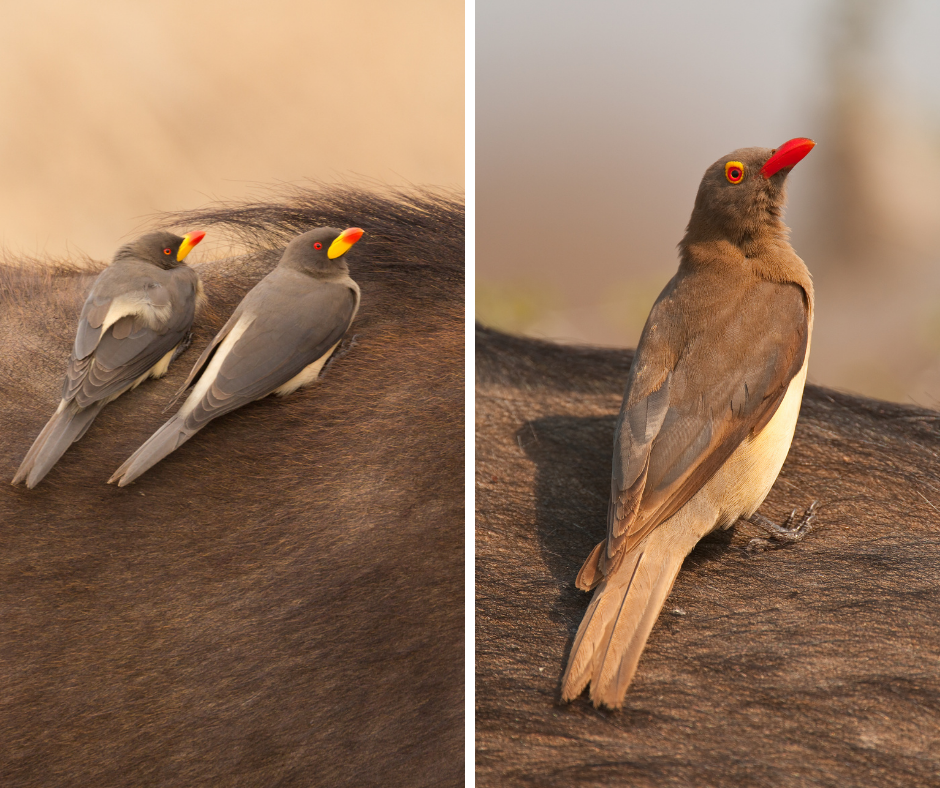
The two species overlap in range across much of sub-Saharan Africa and are often seen together on the same host. In Kruger National Park both species are present. The Red-billed tends to favour smaller and medium-sized hosts; the Yellow-billed shows a stronger preference for larger animals, particularly buffalo.
2. The Bill Is Designed for Parting Hair, Not Probing
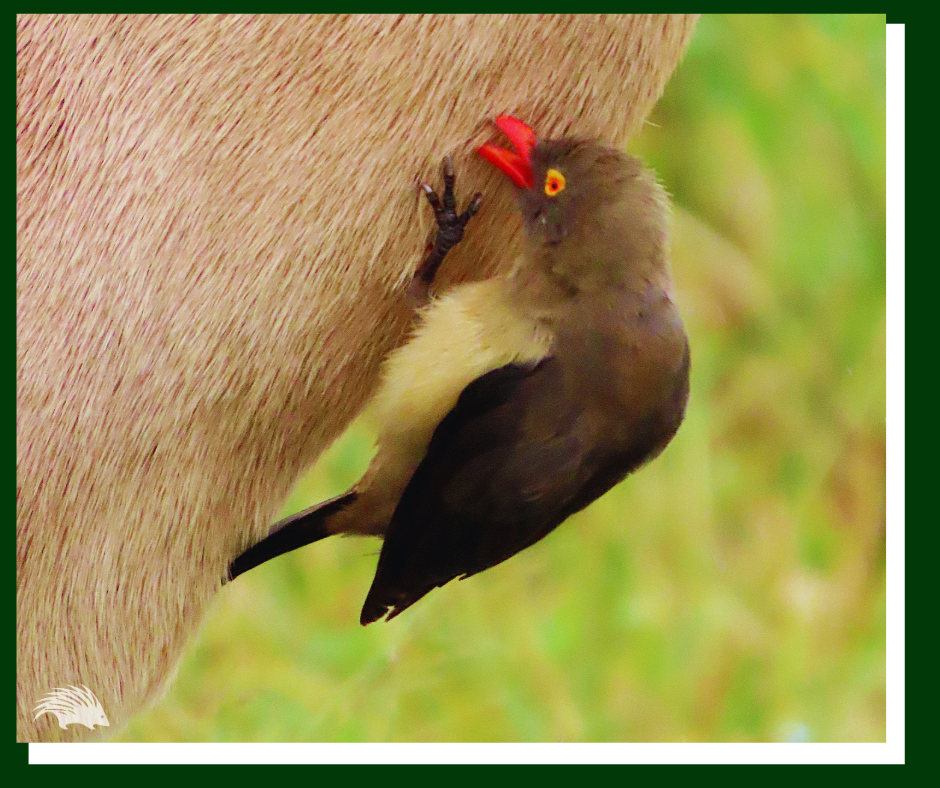
The oxpecker's bill is distinctly flattened sideways, a shape called laterally compressed. This is not a bill for probing into soil or bark like a woodpecker. It is designed to be pushed through the hair or fur of a mammal, parting it to expose the skin and whatever is living there: ticks, lice, flies, and other ectoparasites.
The bill action is scissor-like, opening and closing rapidly as the bird works through a patch of hide. The feet are strongly clawed and zygodactyl (two toes forward, two back), which allows the bird to cling to a vertical hide surface or hang sideways on a moving animal without losing grip. An oxpecker can maintain its position on a galloping impala.
3. They Prefer Hosts with More Ticks
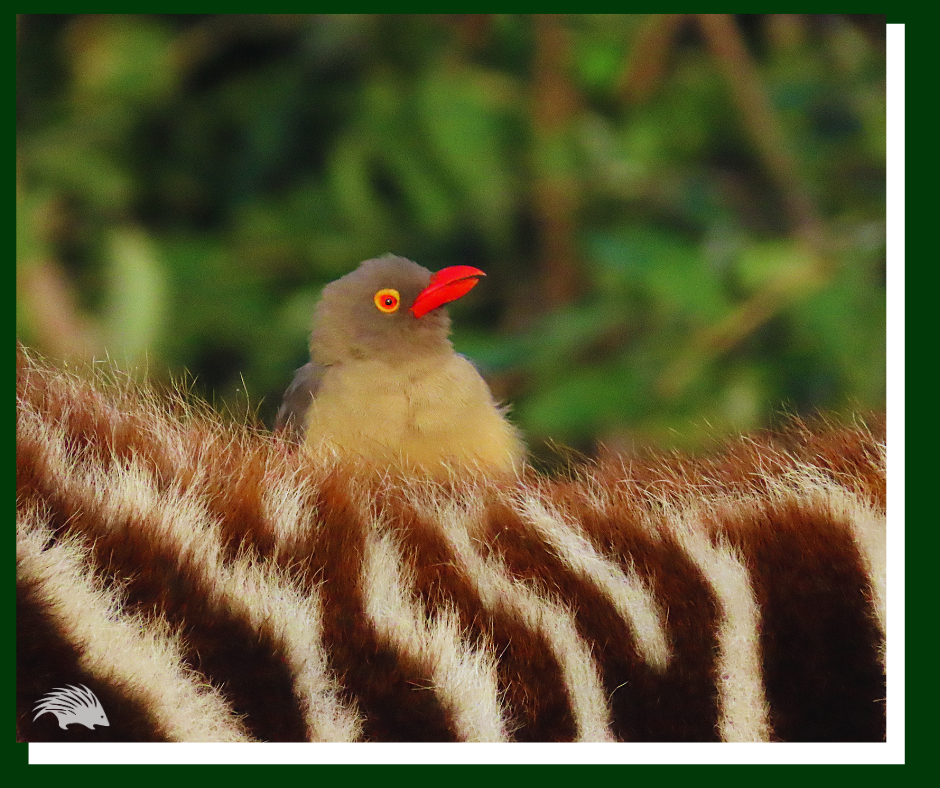
Research published in the journal Evolution (Nunn et al., 2011) found that both Red-billed and Yellow-billed Oxpeckers show a clear preference for host species that carry more ticks. This supports the idea that tick removal is a genuine part of what they are doing, not incidental foraging. They are not simply riding the largest or most accessible animals: they are choosing the ones with the most food.
The same study found no significant evidence that hide thickness (a potential indicator of how easily the birds could wound-feed) drove host preference. The tick load relationship was the stronger signal. A buffalo with a heavy tick burden is a more attractive host than a zebra with a lighter one, regardless of body size.
4. They Also Eat Blood, Wound Tissue, and Earwax
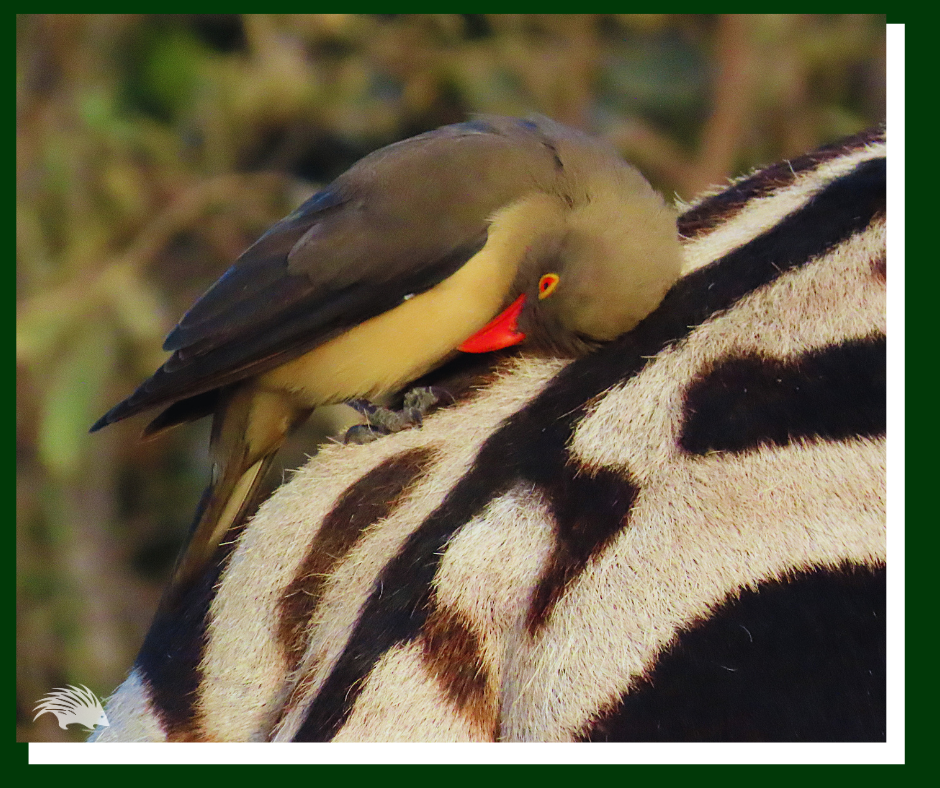
Tick removal is the part of the relationship that benefits the host. The rest is more complicated. Oxpeckers are also documented consumers of blood (from open wounds and by opening small cuts of their own), wound tissue, dead skin, earwax, and mucus. These behaviours have been observed in wild populations across multiple studies.
Wound-feeding is the most discussed: oxpeckers have been seen keeping wounds open by repeatedly picking at healing tissue, which prevents closure and allows continued access to blood. Studies in Kruger found that wound-feeding was most commonly observed on giraffe, where it accounted for around 5 to 6 percent of observed feeding behaviour in both species. On most other hosts it was less frequent, but it was not absent.
5. The Relationship Is Best Described as Facultative Mutualism
For decades, oxpeckers were held up as a textbook example of mutualism: both species benefit, neither is harmed. The research since the 1990s has complicated that picture significantly. The current scientific consensus describes the relationship as facultative mutualism: mostly beneficial, but with situations where the bird's behaviour is clearly costly to the host.
The direction and degree of benefit depends on the individual host, the tick burden, the condition of the animal, and what the oxpecker happens to be eating at any given moment. For a buffalo carrying a heavy tick load, the bird is probably net beneficial. For a giraffe with an open wound that the oxpecker is keeping open, the relationship has shifted toward something more like parasitism. Both states are documented in the same species in the same park.
6. Some Hosts Tolerate Them; Others Actively Reject Them
Not all large mammals accept oxpeckers equally. Buffalo, rhino, elephant, giraffe, and hippo generally tolerate them well and often appear indifferent to their presence. Impala and kudu are more selective, tolerating oxpeckers in some areas and shaking them off in others.
Cattle are notably intolerant. Research on domestic cattle in Zimbabwe found that the cattle successfully displaced oxpeckers significantly more often than wild hosts did, reducing the time the birds could spend foraging. The study suggested that domestic animals may have lost some of the tolerance for ectoparasite-feeding birds that wild ungulates developed over millions of years of co-evolution. Domestic animals also tend to be treated with acaricides (tick-killing chemicals), which reduces the tick load and therefore the incentive for the oxpecker to stay.
7. They Are Alarm Systems
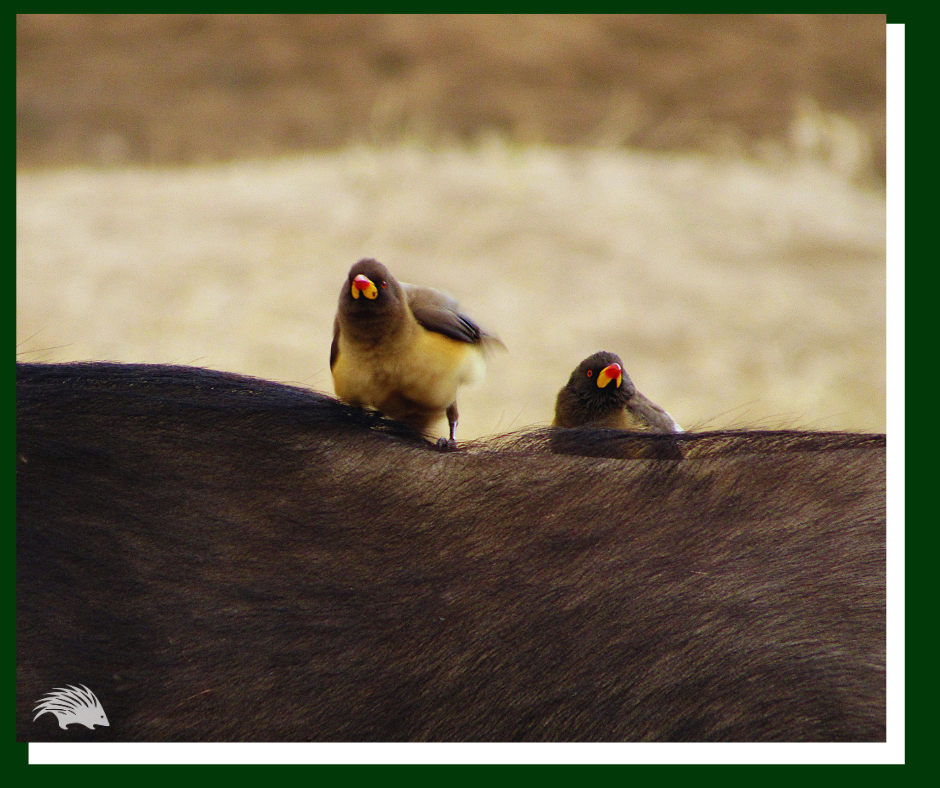
One consistent benefit oxpeckers provide to their hosts is predator detection. When a threat approaches, oxpeckers produce a sharp, hissing alarm call, the 'tsik-tsik' sound audible at close range, and take off from the host animal's back. This gives the host an early warning it would not otherwise have from an animal perched on its own body with an elevated vantage point.
Research on rhino in particular has documented oxpecker alarm behaviour as a reliable signal that humans or predators are approaching. The Swahili name for the Red-billed Oxpecker, Askari wa kifaru, translates as 'the rhino's guard', a name that reflects generations of observation of exactly this behaviour. The alarm function appears consistent across hosts and is one of the clearer benefits in the relationship.
8. They Nest in Tree Cavities and Line the Nest with Host Hair
Oxpeckers are cavity nesters, using holes in trees to nest, typically old woodpecker or barbet holes or natural rot cavities. They line the nest with hair pulled directly from their hosts, which is the one context in which the hair-pulling behaviour is entirely unambiguous in its purpose. Both species breed in the southern African summer, from around September to January.
They are cooperative breeders: a breeding pair is often assisted by additional adults (usually offspring from previous seasons) that help incubate eggs and feed chicks. The group roosts together on a host animal at night, clinging to the hide as the animal sleeps.
9. Their Populations Depend Directly on Large Mammal Populations
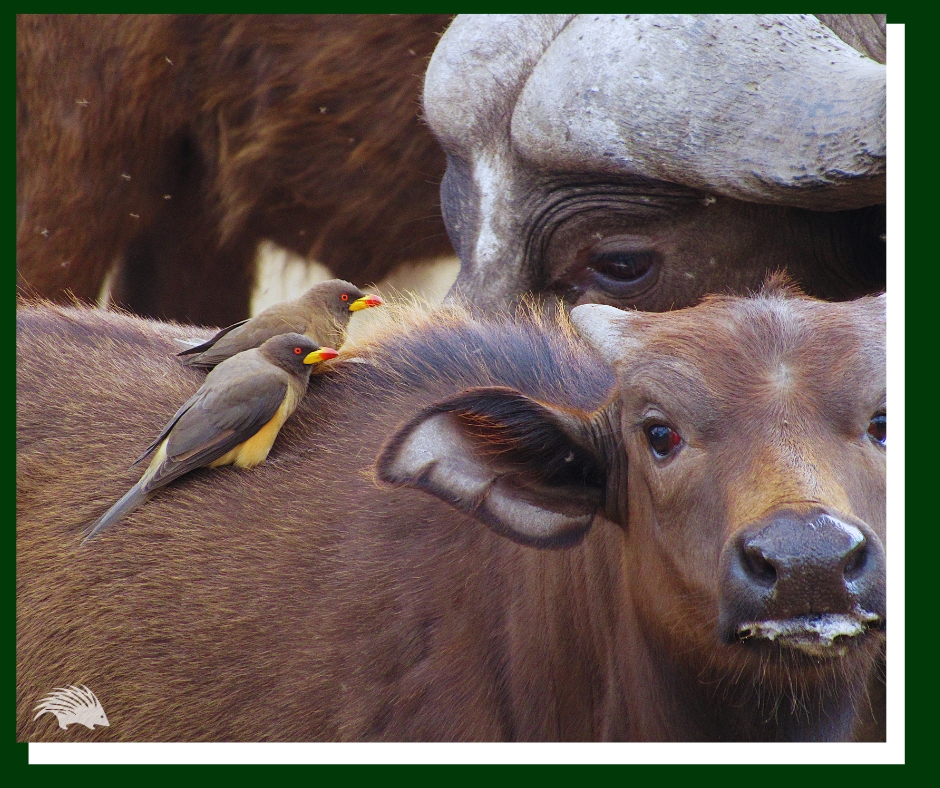
Oxpeckers cannot survive without large mammals. They are obligate associates: they feed on them, roost on them, pull nesting material from them, and have no ecological substitute for them. This makes them unusually vulnerable to large mammal population declines.
A study published in PLOS ONE found that oxpecker densities were lowest in areas with the least protection for large mammals and highest in fully protected reserves. Where poaching, hunting, or habitat loss reduces buffalo, rhino, and giraffe numbers, oxpecker populations follow. In areas where large mammals were extirpated in the twentieth century and have since been reintroduced, oxpeckers have returned alongside them.
10. They Are Easy to See in Kruger and Around Marloth Park
Both species are common in Kruger National Park and are regularly seen on game drives from Needles Lodge in Marloth Park. The easiest sightings come from finding a buffalo or giraffe with birds on their backs: a stationary or slow-moving herd allows the birds to settle and work without disturbance, and from a vehicle you can watch the feeding behaviour in detail.
Frequently Asked Questions
Are oxpeckers helpful or harmful to the animals they ride?
The honest answer is both, depending on the situation. Oxpeckers remove ticks and other ectoparasites, which benefits the host, and their alarm calls warn hosts of approaching predators. But they also feed on blood, wound tissue, and earwax, and have been documented keeping wounds open by picking at healing tissue. Scientists now describe the relationship as facultative mutualism: mostly beneficial, but with situations where the bird's behaviour is clearly costly to the host.
What is the difference between a Red-billed and Yellow-billed Oxpecker?
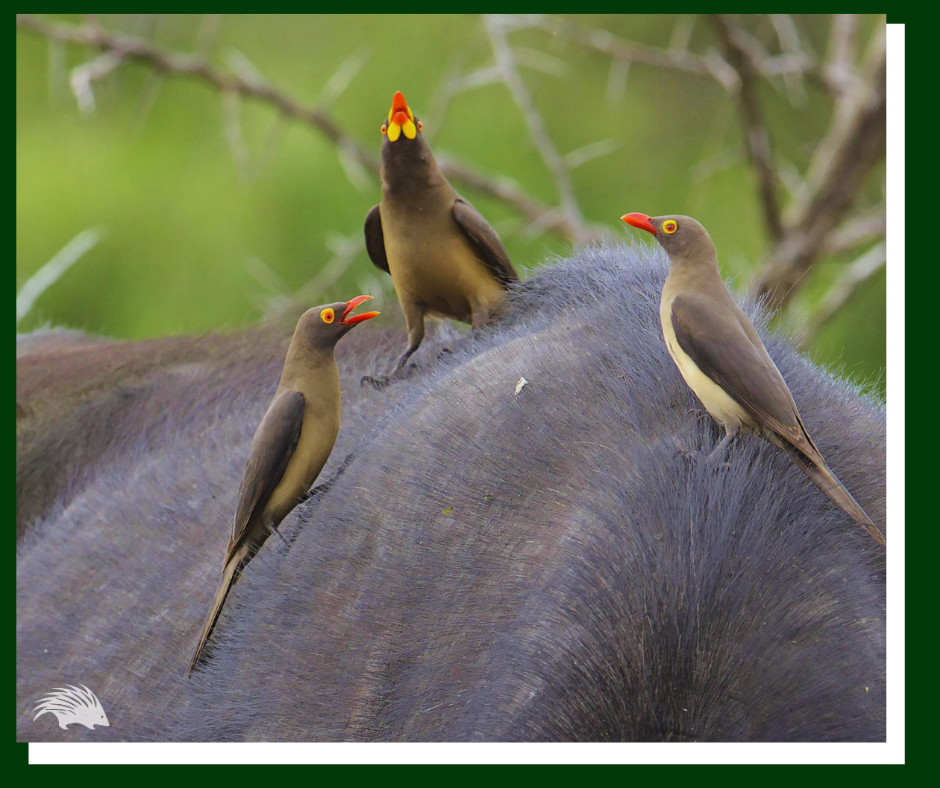
The bill colour is the main identifier: the Red-billed Oxpecker has an entirely red bill; the Yellow-billed has a yellow bill with a red tip. The Yellow-billed is slightly larger and shows a stronger preference for buffalo. Both have yellow eyes. Both species are present in Kruger National Park and are often seen together on the same host animal.
Why do some animals accept oxpeckers and others shake them off?
Host tolerance varies by species and individual. Buffalo, rhino, elephant, and giraffe generally tolerate oxpeckers. Cattle are notably intolerant and displace the birds more frequently than wild hosts. The degree of tolerance appears to be influenced by co-evolutionary history: wild ungulates have lived alongside oxpeckers for millions of years, while domestic cattle have not developed the same tolerance. Tick load also matters: a host with few ticks has less to gain from the arrangement and may be less tolerant.
Do oxpeckers really drink blood?
Yes, though this is not their primary food source. Oxpeckers have been documented opening small cuts, feeding from existing wounds, and keeping wounds open to access blood and wound tissue. This behaviour is most frequently recorded on giraffe, where it accounts for a small but consistent proportion of observed feeding. On most other host species it is less common. The majority of their diet is ticks, other ectoparasites, dead skin, and mucus.
Where is the best place to see oxpeckers near Marloth Park?
The best oxpecker sightings come from finding buffalo, giraffe, or rhino in Kruger and watching the birds on their backs at close range. The southern section of Kruger, accessible from Needles Lodge via the Crocodile Bridge and Malelane gates, has both species regularly. Buffalo herds with attendant oxpeckers are common along the river roads in the dry season. Giraffe between Crocodile Bridge and Lower Sabie frequently carry Red-billed Oxpeckers around the neck and ears.
What does the oxpecker alarm call sound like?
A sharp, hissing 'tsik-tsik' repeated rapidly when the bird detects a threat. It is loud enough to be heard clearly from a vehicle. The call triggers an immediate response in the host animal, which raises its head and scans for danger. In Swahili, the Red-billed Oxpecker is called Askari wa kifaru, meaning 'the rhino's guard', reflecting the long-recognised alarm function of the bird.
Both oxpecker species are regular sightings on guided game drives from Needles Lodge in Marloth Park. The southern Kruger roads via Crocodile Bridge and Malelane gates offer consistent access to the buffalo, giraffe, and rhino that carry them. Get in touch to plan your visit.

Share This Post