

Discover guided walks, birding, history, and family-friendly fun near Needles Lodge in Marloth Park—beyond the traditional safari.
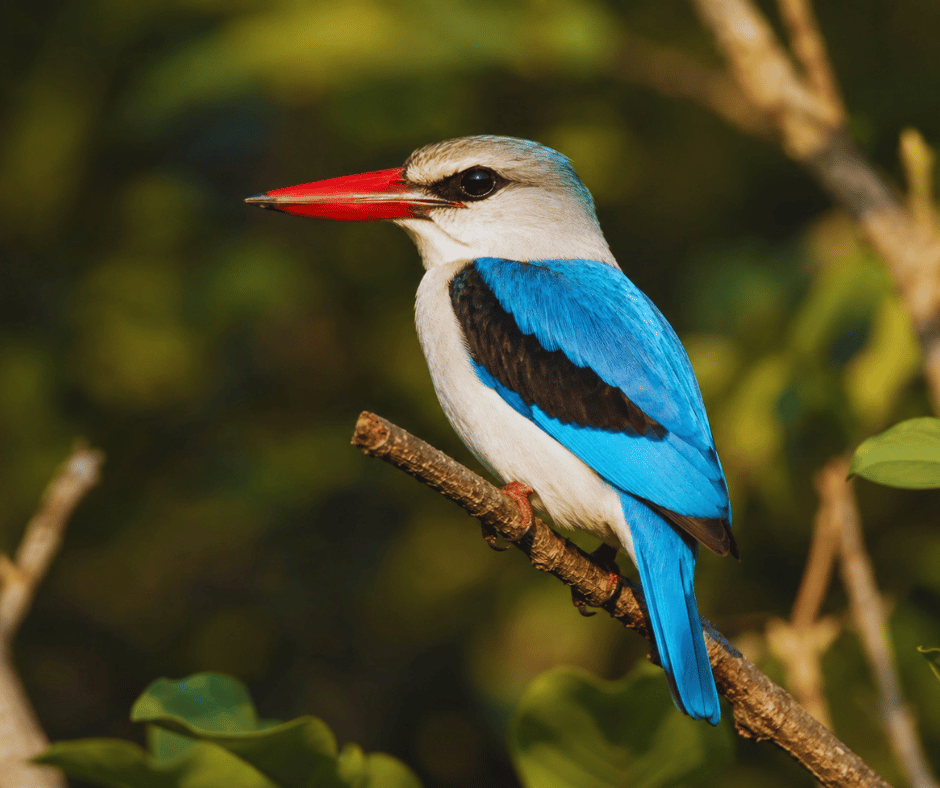
Everything you need to know about the Woodland Kingfisher (, the electric-blue summer visitor that announces the wet season across Marloth Park and the Kruger bushveld.
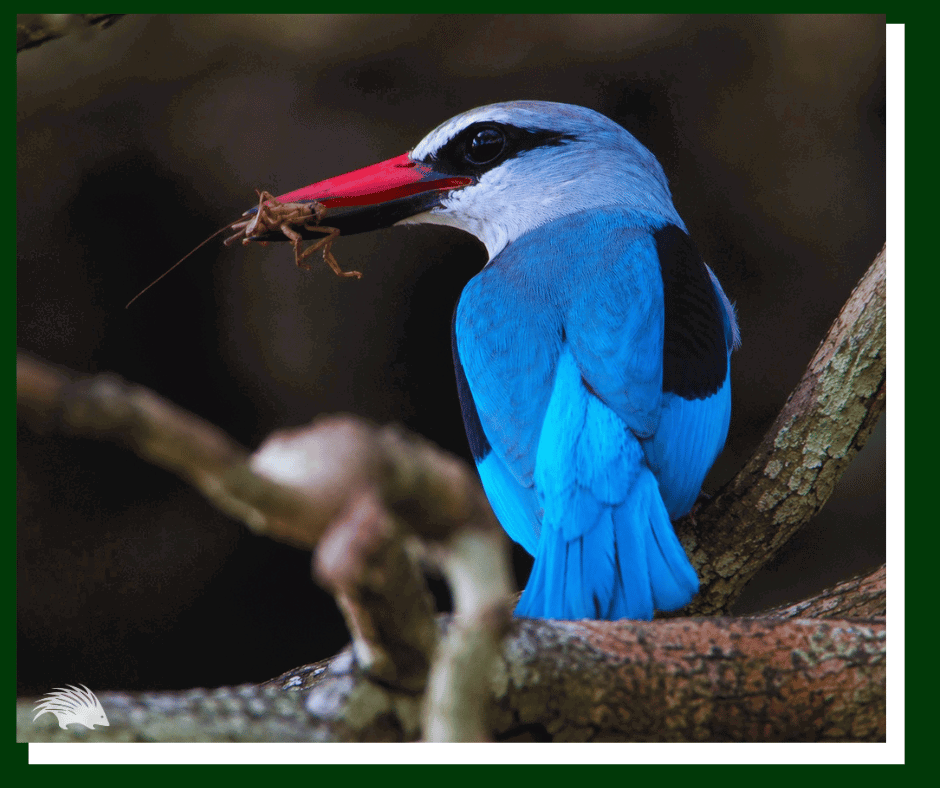
If you have spent a summer morning at Needles Lodge or on a game drive through the southern section of Kruger, you have probably heard a Woodland Kingfisher before you saw one. The call comes first: a sharp, piercing whistle followed by a descending trill that carries clearly through the trees. Then, if you are patient, the bird itself appears on a dead branch, electric blue against the green of the wet-season bush.
The Woodland Kingfisher is one of the most recognisable birds of the African summer. Here are ten things worth knowing about it.
1. It Arrives with the First Rains
The Woodland Kingfisher is not a year-round resident in the Lowveld. It is an intra-African migrant that arrives in southern Africa between October and November, just as the first summer rains begin, and departs again in March and April.
The birds that visit southern Africa belong to the subspecies Halcyon senegalensis cyanoleuca, which breeds here during the wet season and moves north to equatorial Africa for the southern winter. Migration happens mostly at night.
2. The Call Travels Further Than You Expect
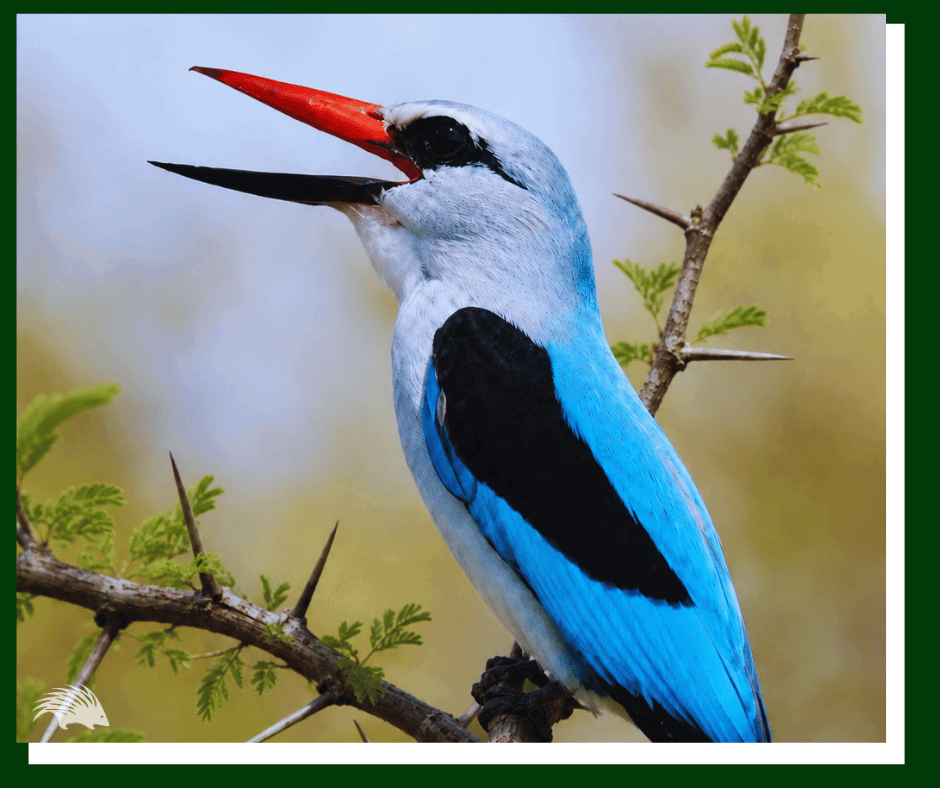
The Woodland Kingfisher's call is loud for the size of the bird. It begins with a sharp, high-pitched whistle, written as tuuui, followed by a pause and then a rapid, descending trill that sounds like a fingernail drawn across the teeth of a comb. The full call carries clearly across open woodland and through dense riverine vegetation.
Males call persistently from exposed perches to announce territory, particularly in the early morning hours.
3. It Is Not a Water Bird
Despite being a kingfisher, the Woodland Kingfisher does not depend on water. It hunts in dry woodland, acacia savanna, and forest edges, often well away from rivers or waterholes. Its diet is mostly insects, with lizards, frogs, millipedes, and the occasional small snake making up the rest. Fish are a very small part of what it eats, and only where water is nearby.
This is a useful identification point. If you see a bright blue kingfisher perched on a dead branch in the middle of dry bush, well away from any water, it is almost certainly a Woodland Kingfisher.
4. The Plumage Is Hard to Miss
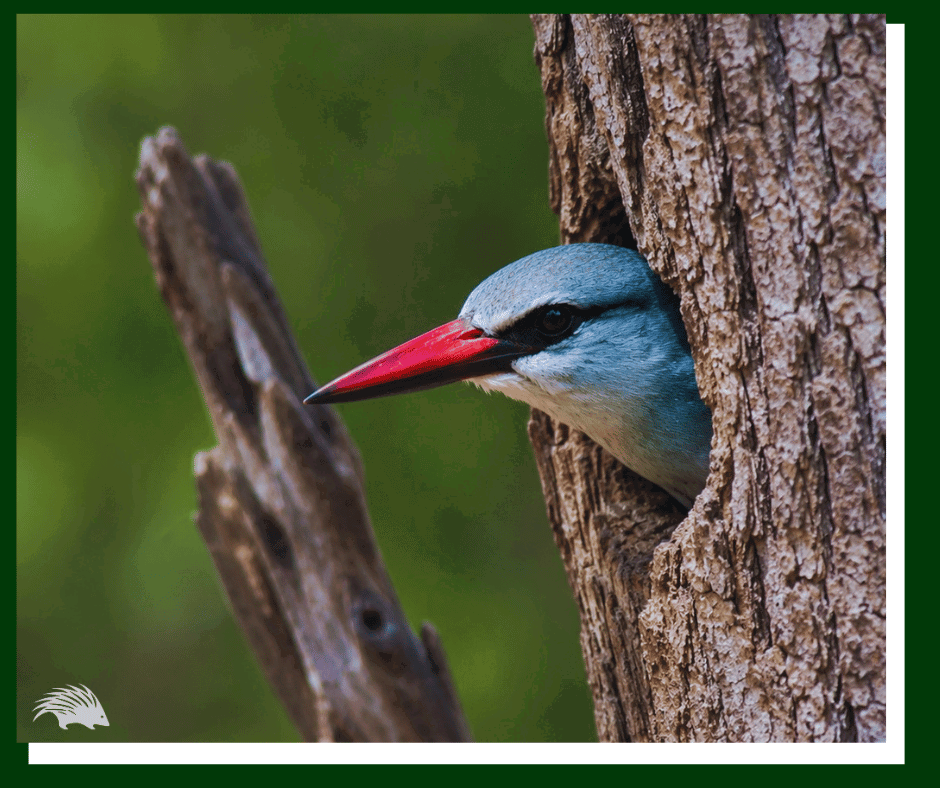
The adult Woodland Kingfisher has a bright blue back, wing panel, and tail. The head and underparts are white, the shoulders
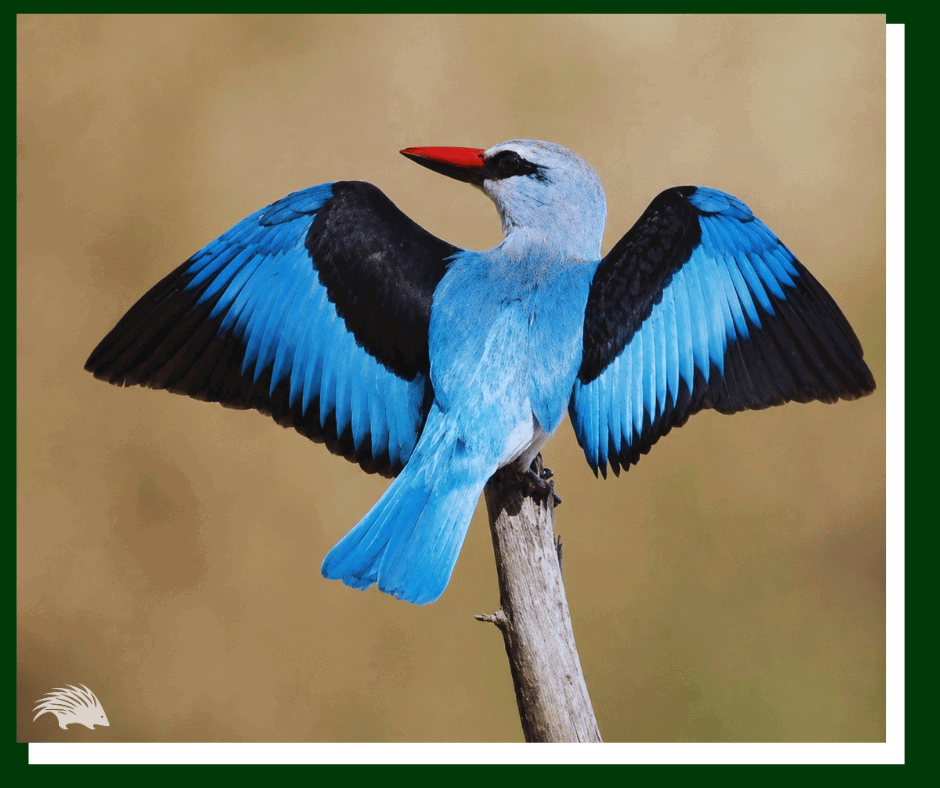
are black, and the bill is bicoloured: red on the upper mandible and black on the lower. The legs are red. In flight, the wings show black primaries with white underwing coverts, producing a bold pattern that is visible from a distance.
The bicoloured bill is the clearest way to separate it from similar species. The Brown-hooded Kingfisher, which shares the same woodland habitat across much of its range, has an all-orange bill. The Mangrove Kingfisher is very similar in appearance, but the dark stripe through the eye does not extend as far, and it prefers coastal and mangrove habitats rather than dry inland woodland.
5. It Hunts from a Perch
The Woodland Kingfisher is a sit-and-wait hunter. It takes up a position on a dead branch or exposed perch with a clear view of the ground below, watches for movement, then drops fast to seize prey. The attack is direct and brief. The bird returns to its perch immediately, beats larger prey against the branch to stun it, and swallows it head-first.
It takes insects most often, including beetles, grasshoppers, and flying termites when these are available. Lizards are a regular prey item, and the bird handles them competently despite its relatively modest size.
6. It Nests in Tree Holes, Often Taken from Others
The Woodland Kingfisher nests in cavities, typically a hole in a dead tree or branch. It does not excavate its own holes. Instead, it takes over existing cavities, including old woodpecker or barbet holes and natural rot cavities in trunks. It will compete aggressively for a suitable site.
The female lays two to four white, glossy eggs. Both parents incubate and feed the chicks. The breeding season in southern Africa runs from November to March, coinciding with the wet season when insect prey is most abundant.
7. It Is Aggressively Territorial
The Woodland Kingfisher defends its territory actively and without hesitation. It will chase other birds from its perch area, confront intruding kingfishers, and has been recorded attacking humans who approach too closely to a nest site.
The territorial display involves spreading the wings wide to show the bold black and white underwing pattern, combined with loud calling. The wing-spread display is used both against rival kingfishers and as a warning to larger animals approaching the nest.
For a bird weighing under 80 grams, the confidence is notable.
8. The Name Halcyon Comes from Greek Mythology
The genus name Halcyon comes from the ancient Greek myth of Alcyone, a daughter of the wind god Aeolus, who was transformed into a kingfisher. The myth described a period of calm winter weather, the halcyon days, during which the bird was said to nest on the surface of a becalmed sea.
The name was applied to tree kingfishers by the English naturalist William Swainson in 1821, with the Woodland Kingfisher as the type species for the genus.
The species name senegalensis means “of Senegal”, where the species was first formally described. Carl Linnaeus included it in the twelfth edition of his Systema Naturae in 1766, based on an earlier description by the French naturalist Mathurin Jacques Brisson.
9. It Shares Its Habitat with Several Similar Species in Kruger
In Kruger National Park, the Woodland Kingfisher shares its woodland habitat with the Striped Kingfisher and, near water, the Giant Kingfisher and Pied Kingfisher. The Woodland Kingfisher is the brightest and loudest of the dry woodland group, and its call is the most distinctive.
It also often occurs in the same habitat as the Brown-hooded Kingfisher without serious conflict, with the two species taking slightly different prey sizes and hunting in slightly different microhabitats. The Woodland Kingfisher tends to use higher, more exposed perches, while the Brown-hooded Kingfisher works lower in the vegetation.
10. It Is One of the Easiest Summer Birds to Find in Marloth Park
From November to March, Woodland Kingfishers are present and calling throughout Marloth Park. The open bush, the dead branches that make ideal perches, and the insect abundance of the wet season all suit the bird well.
It is not shy. It perches in full view, calls repeatedly, and can be watched closely without flushing easily from an established perch.
Guests at Needles Lodge often see Woodland Kingfishers from the deck or the garden during the summer months, without needing to go further than the property itself. The early morning call, starting before full light, is one of the characteristic sounds of a Lowveld summer.
Frequently Asked Questions
When can you see Woodland Kingfishers in Marloth Park and Kruger?
Woodland Kingfishers arrive in southern Africa between October and November and depart in March and April. They are present in Marloth Park and Kruger throughout the wet season. The peak of calling activity is November to February, when males are most actively defending breeding territories.
Do Woodland Kingfishers eat fish?
Rarely. Despite the name, Woodland Kingfishers eat mainly insects, along with lizards, frogs, millipedes, and small snakes. Fish form a very small part of the diet and only where water is immediately nearby. The bird hunts in dry woodland and is regularly found well away from any water source.
How do you identify a Woodland Kingfisher?
Look for a medium-sized bird, measuring 20 to 24 centimetres, with a bright blue back, white head and underparts, black shoulders, and a distinctive bicoloured bill: red on top and black below. The bold black and white underwing pattern is visible in flight. The loud, descending trill call is the most reliable identification feature at a distance.
What does a Woodland Kingfisher call sound like?
The call starts with a sharp, high-pitched whistle followed by a pause and then a rapid, descending trill. It has been described as sounding like a fingernail drawn across the teeth of a comb. The call carries well through dense vegetation and is one of the characteristic sounds of the African wet-season bush.
Is the Woodland Kingfisher the same as other kingfishers in Kruger?
No. Several kingfisher species occur in and around Kruger. The Woodland Kingfisher is distinguished from the Brown-hooded Kingfisher by its all-blue back, rather than a brown-washed back, brighter plumage, and bicoloured bill.
The Pied Kingfisher and Giant Kingfisher are water-dependent species and look completely different. The Striped Kingfisher is smaller and more streaked. The Woodland Kingfisher is the loudest and most brightly coloured of the dry woodland group.
Where does the Woodland Kingfisher go in winter?
Southern African Woodland Kingfishers migrate north to equatorial Africa between March and April, returning the following October or November. Migration is mostly nocturnal. The birds that breed in the Kruger and Marloth Park area are absent from May to September.
Experience Summer Birding at Needles Lodge
Needles Lodge in Marloth Park is well placed for summer birding. Woodland Kingfishers are regular on the property from November through March, and the surrounding bush holds a wide range of wet-season migrants and resident species.
Get in touch to plan your visit.

Share This Post